Table of Contents
Quick Answer
Humor in children’s literature often takes familiar characters and spins them in unexpected, delightful directions, creating laughter and engagement. Santa Claus, with his universal recognition and jolly image, becomes a perfect canvas for humor, allowing authors to transform him into a meme-like figure that tickles the funny bones of both kids and adults. Incorporating humor into children’s books turns Santa into a meme by reimagining his character in playful, exaggerated ways.
This playful transformation serves as a springboard for understanding why humor plays such a unique and vital role in children’s literature.
What Makes Humor in Children’s Books Unique?
Humor in children’s books is a magical concoction that spins familiar elements into whimsical tales. A key ingredient is crafting comedic elements specifically for kids. Unlike adult humor, which often relies on sarcasm or complex wordplay, children’s humor thrives on simplicity and surprise. It’s the unexpected twist that makes a child giggle, like a cat wearing a hat or a snowman that can talk. Kids love the absurdity and silliness that comes from seeing the world turned upside down.
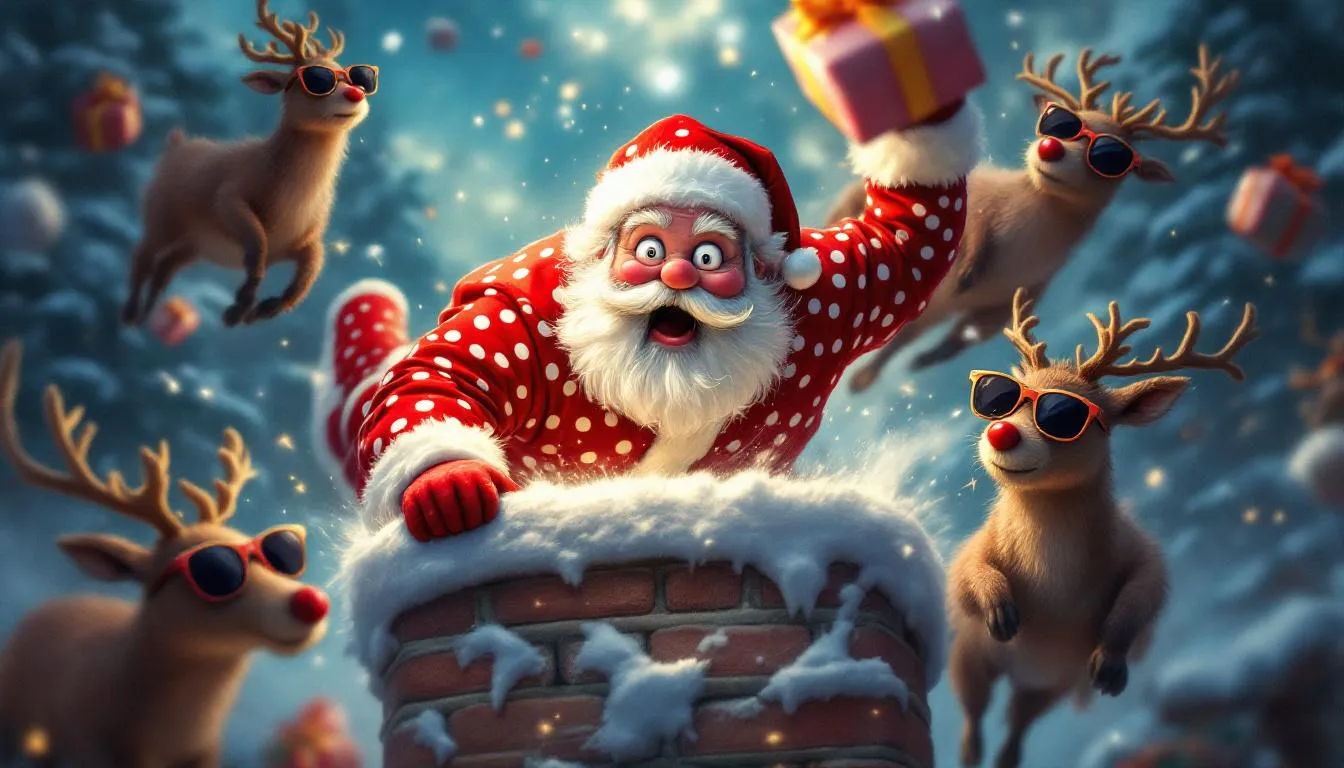
Illustrations and wordplay also play an essential role. Funny illustrations are like the cherry on top of a delightful cake, bringing humor to life. Consider a picture book where Santa zips down a chimney in polka-dot pajamas or gets stuck in a tree with a reindeer. These images don’t just accompany the story; they tell a tale of their own. When my daughter was little, she adored a book where Santa’s sleigh was pulled by flamingos instead of reindeer. The picture alone had us both in stitches!
Wordplay, too, is pivotal in children’s books. Puns and rhymes make reading interactive and fun. “Santa Claus is coming to cow-town!” can turn into a hilarious adventure with cows wearing Santa hats. This playful use of language entertains while helping children develop a love for words and reading.
These unique aspects of humor in children’s books transform familiar characters, setting the stage for them to become something entirely new and memorable.
How Does Santa Become a Meme in Children’s Books?
Santa Claus, the beloved and jolly gift-giver, becomes a hilarious figure in children’s books by being placed in outlandish situations. Authors often depict Santa in humorous predicaments that play with his traditional image, giving him new life as a meme-like character.
Consider a story where Santa accidentally swaps his sleigh for a spaceship and ends up delivering gifts on Mars. This kind of unexpected twist fuels imagination and laughter. Illustrations might show Santa in an astronaut suit, trying to fit through a chimney on a Martian home. This not only provides a good laugh but also reimagines Santa in ways that children find endlessly amusing.
Parody and satire add layers of humor to Santa’s portrayal. By exaggerating his traits or placing him in unlikely scenarios, authors create a version of Santa that both pokes fun and pays homage to the traditional figure. Imagine a book where Santa is trying to go on a diet but can’t resist the cookies left out by children. The story might include a scene where he’s caught sneaking a cookie by Mrs. Claus, complete with a cheeky grin and a guilty look.
These playful reinterpretations highlight Santa’s character’s flexibility, allowing children to see him in a new light. As these humorous portrayals capture the imagination, they open the door to broader discussions about the importance and impact of humor in children’s literature.
Why Is Humor Important in Children’s Books?
Humor in children’s books goes beyond causing giggles and laughter; it significantly contributes to a child’s development, acting as a catalyst for emotional growth and cognitive skills.
First, consider the developmental benefits. Laughter is a universal language that helps children connect with others. When kids share a funny story or joke, it fosters social bonds and encourages empathy. It’s like when my son burst into laughter reading about a clumsy elf in one of his favorite books, and suddenly, all his friends wanted to hear it too. This shared joy strengthens friendships and builds confidence in social settings.
Humor also aids in stress relief, offering a safe outlet for children to navigate complex emotions. Picture a child giggling at Santa tripping over his beard and learning to handle mishaps with a smile.
Moreover, humor nurtures creativity and critical thinking. It invites children to see things from different perspectives, challenging them to think outside the box. Consider a story where Santa’s reindeer are replaced by kangaroos; it prompts kids to imagine the logistics, sparking creativity. As they laugh, they’re also engaging in problem-solving, asking questions like, “How would Santa steer them?”
When woven into storytelling, humor becomes a powerful educational tool. It enhances vocabulary, comprehension, and memory retention, as funny content is far more memorable. As we continue exploring how authors craft these unforgettable humorous moments, we’ll see the magic unfold in children’s literature’s delightful pages.
How Do Authors Create Memorable Funny Moments?
Creating laugh-out-loud moments in children’s books requires a blend of clever techniques and a careful balance between humor and storyline. Authors have a delightful toolbox at their disposal to craft these memorable funny moments.
Exaggeration and Absurdity
Exaggeration is highly effective—taking a familiar situation and blowing it up to comical proportions. Imagine Santa squeezing down a too-small chimney, only to pop out the fireplace covered in soot with a bewildered expression. This larger-than-life humor is easy for kids to grasp and instantly funny.
Unexpected Twists
Children love surprises, and unexpected plot twists are a fantastic way to tickle their funny bones. Picture Santa accidentally delivering a gift meant for a penguin to a polar bear. The ensuing confusion and resolution can lead to a hilarious narrative.
Relatable Mishaps
Authors incorporate relatable mishaps with a humorous twist. Like the time Santa misplaces his sleigh keys and borrows a bicycle to deliver presents. These scenarios are funny and allow kids to relate and learn from the characters’ adventures.
Dialogue and Wordplay
Snappy dialogue and clever wordplay add another layer of humor. A conversation between Santa and a cheeky elf might be filled with puns that keep readers giggling. These playful exchanges make the story interactive and engaging.
Balancing humor with the storyline is crucial. Jokes should enhance the plot, not overshadow it. A well-placed joke or funny situation provides a pause in the narrative, giving readers a moment of levity before diving back into the story.
As we explore the next section, we’ll delve into beloved books where Santa’s humorous escapades take center stage, enchanting young readers and leaving them in stitches.
What Are Some Popular Children’s Books Featuring a Humorous Santa?
Some real gems in children’s literature feature a humorous Santa, tickling the funny bones of kids and adults alike. Here are a few titles that bring Santa to life in a hilariously entertaining way:
- “Santa’s Underwear” by Marty Rhodes Figley: This book takes a comical turn as Santa prepares for his big night, only to discover his special Christmas underwear is missing! The story follows Santa as he searches high and low for his favorite pair, showcasing the silliness of a predicament many kids can relate to—losing that one special item. My kids couldn’t stop giggling at the idea of Santa in polka-dot boxers.
- “How Santa Got His Job” by Stephen Krensky: Ever wondered what Santa did before becoming the beloved gift-giver? This book humorously explores Santa’s various jobs before he landed his current role. From zookeeper to chef, each job has a funny twist that makes young readers chuckle. It’s a delightful tale showing how even Santa had to find his calling.
- “When Santa Lost His Ho! Ho! Ho!” by Laura Rader: In this heartwarming and funny story, Santa loses his iconic “Ho! Ho! Ho!” and goes on a quest to find it. The book is filled with humorous situations and lively illustrations that keep kids engaged, like when Santa tries to laugh like other characters, from a witch’s cackle to a pirate’s “Arrr!” It’s a fun reminder that laughter is contagious.
These books entertain and highlight how humor creates memorable and engaging stories for children. As we wrap up our exploration of Santa’s comedic adventures, it’s time to reflect on the insights we’ve gathered from these tales.
Key Takeaways
- Humor in children’s books fosters social bonds and empathy through shared laughter.
- Reimagining traditional characters like Santa sparks creativity and expands children’s imaginations.
- Funny scenarios help children navigate emotions, offering stress relief and a positive outlook on problem-solving.
- Humorous storytelling enhances language skills, making reading joyful and memorable.
- Encouraging humor in reading can instill a lifelong love of books and learning.
Let humor be the magic that transforms your child’s reading journey into a world of endless possibilities and laughter.